An Odoo storefront does not have to look like an Odoo storefront
We design Odoo websites for consumer brands selling direct: editorial storefronts with real photography, collections that tell a story, and the repeat-purchase mechanics that decide whether a first order becomes a customer.
The objection is that Odoo shops look generic. Usually the shop was never designed
A consumer brand needs things a B2B catalogue never asks for: photography that carries the product, a story that survives the product page, and a reason to come back. Those are design decisions, and they are the ones most often skipped when a webshop is treated as an ERP module.
The default theme is the brand
Typography, spacing and layout arrive from the platform rather than from the brand, and every competitor running the same stack looks the same.
Photography is treated as an afterthought
Product shots are inconsistent in crop, background and light, so a page of them reads as a spreadsheet rather than as a collection.
The story stops at the homepage
The brand is explained once, then abandoned. The product page, which is where the decision is actually made, sells on specifications.
Collections are just categories
A collection is a reason to buy several things together. Treated as a filter, it does none of that work.
Nothing is built for the second order
Acquisition gets the attention, but a D2C brand lives on repeat purchase, and the site offers no reason or mechanism to come back.
Stock and fulfilment stay invisible
The information that prevents a cancelled order (availability, delivery window, returns) already exists in Odoo and never reaches the page.
Help the customer answer one question: is this a brand I want to buy from twice?
A consumer storefront has to do two jobs at once: sell the individual product and establish the brand well enough that the next order does not need to be won again from scratch.
A position stated in the design itself, not only in an About page that most customers never open.
Product pages with photography, materials, sizing and use, written for someone choosing rather than specifying.
Collections and pairings built as editorial, so a visit becomes a basket rather than a single item.
Availability, delivery windows, returns and after-sales pulled from Odoo onto the page where the doubt occurs.
Subscriptions, refills, loyalty or a new season, with the mechanics running in the same system as the orders.
Retail, marketplace and wholesale channels handled without the direct storefront losing its own identity.
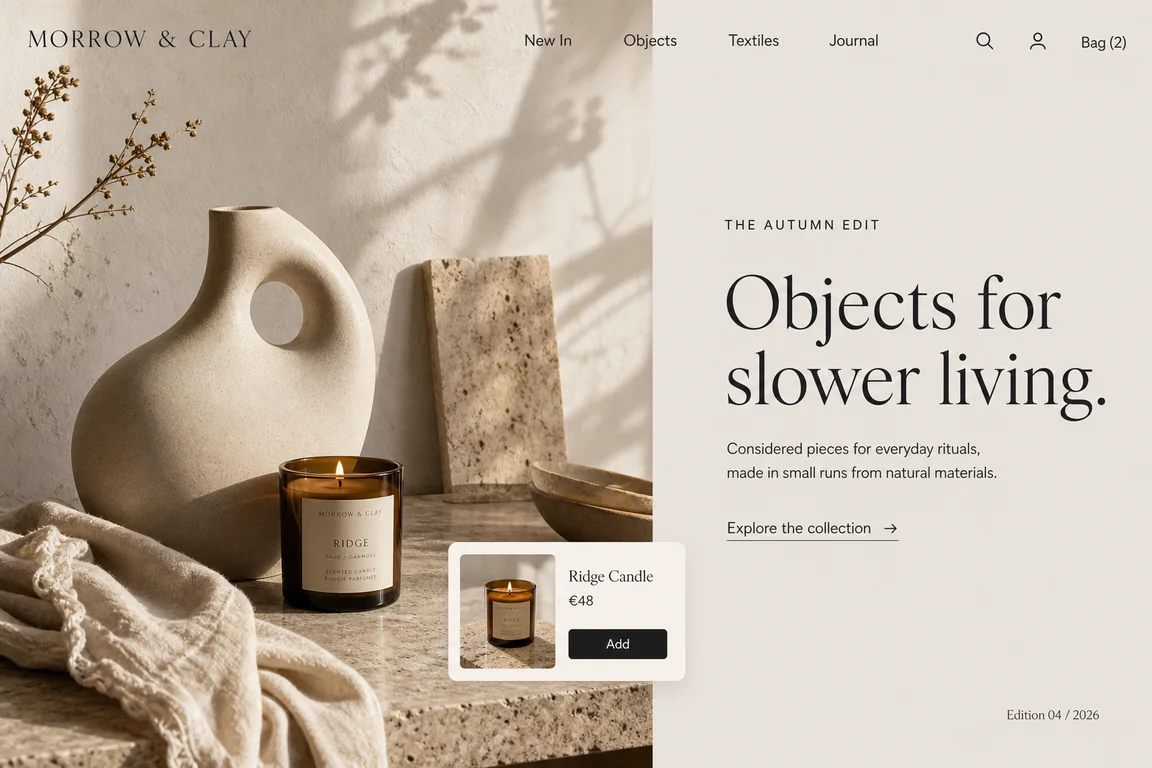
The screenshot above is the argument. This is what it is made of
Morrow & Clay is a concept, not a client, and it runs on the same Odoo eCommerce that produces the generic shops the objection is about. The difference is not the platform. It is that someone made decisions about type, image, rhythm and hierarchy before the products were loaded.
None of the elements below require leaving Odoo, and each one is a decision rather than a setting.
The first order is acquisition. The second one is the business
For a direct-to-consumer brand the interesting part of the journey starts after checkout, and that is precisely the part that runs on the system behind the website.
Story
The visitor lands on a collection or a campaign rather than on a product grid sorted by SKU.
Product
Photography, materials and sizing answer the question, and availability comes straight from stock.
Checkout
Delivery, payment and returns are stated before the doubt has time to become an abandoned basket.
Odoo
Fulfilment, service, subscriptions and the next campaign run on the order data the shop already produced.
Basic for a focused range. Extended for a brand with collections, seasons and repeat purchase
The larger the range and the more the brand depends on returning customers, the more useful the Extended scope becomes.
Brand Storefront
- Custom Odoo design
- Brand-led storefront
- Core collections
- Editorial product pages
- Checkout and delivery content
- Newsletter capture
- CRM integration
- Responsive implementation
Collection & Retention Storefront
- Everything in Basic
- Full collection structure
- Seasonal and campaign templates
- Cross-sell and pairing logic
- Subscriptions or reorder flows
- Customer account area
- Stock and delivery signals
- Multi-channel structure
- Advanced SEO structure
- Multilingual options
We'll show you which parts of the shop are the platform's defaults rather than your brand's decisions
Send us the current storefront. We'll review design and photography, collection structure, product pages, checkout content, repeat-purchase mechanics, mobile UX and how the shop uses what Odoo already knows.